Blog

fb10

International Youth Day 2025 | Empowering Pakistan’s Young Leaders for Innovation and Growth

A Generation Shaping the Present

On International Youth Day 2025, we honor not only the promise of tomorrow — but the power of today.

Pakistan’s youth are no longer waiting for opportunity. They are creating it.

With energy, creativity, and digital fluency, young Pakistanis are reshaping the country’s economic and social trajectory. They are not spectators of progress; they are its architects.

Youth as the Engine of Modern Growth

Over the past six decades, global history has demonstrated that youth populations are catalysts for transformation. In Pakistan, this reality is unfolding across multiple sectors.

Digital Freelancing and Global Online Work

Pakistan ranks among the world’s emerging freelance economies. Young professionals in IT, software development, design, and digital marketing are earning foreign exchange while integrating into global markets.

This is not informal survival — it is structured digital participation in the global economy.

Climate Technology and Renewable Energy

Youth-led startups are pioneering:
• Solar innovation
• Waste management solutions
• Climate adaptation tools
• Green entrepreneurship models

Environmental responsibility is no longer activism alone — it is economic opportunity.

Telemedicine and Health Innovation

Young medical professionals and technologists are expanding telemedicine services to underserved rural areas, bridging geographic inequality through digital health platforms.

Healthcare accessibility increasingly depends on youth-led innovation.

Startups and Entrepreneurial Ecosystems

Pakistan’s startup ecosystem continues to grow, driven largely by youth founders:
• Fintech solutions
• E-commerce platforms
• EdTech innovations
• Agritech modernization

These ventures are not only creating jobs — they are redefining traditional industries.

More…
fb9

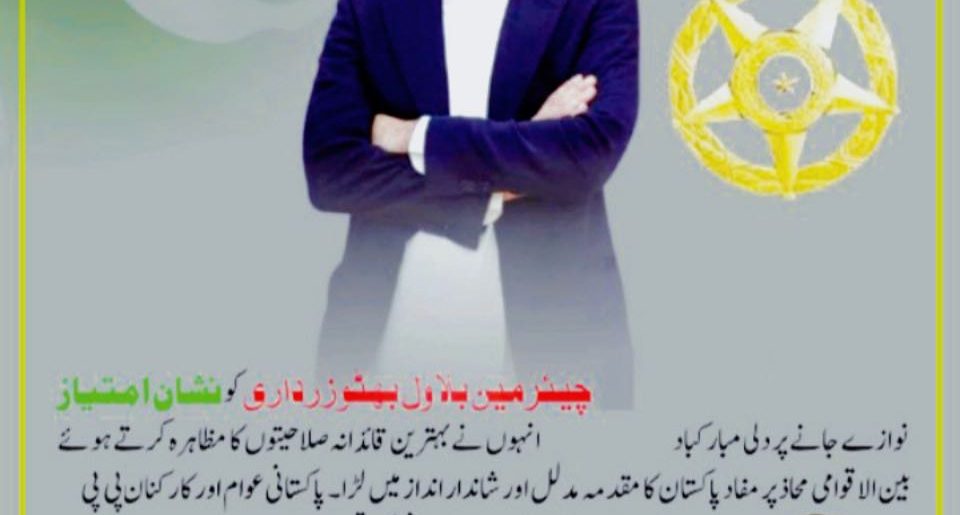
Bilawal Bhutto Zardari Award Recognition | Merit, Diplomacy and National Honor

Recognition and the Culture of Merit

Every nation honors individuals who demonstrate excellence in service, diplomacy, science, arts, or governance. Recognition is not merely ceremonial — it shapes national identity and inspires future generations.

When a public figure receives a civilian award, the question is not partisan preference. The question is merit, measurable contribution, and national representation.

Recent recognition of Bilawal Bhutto Zardari has sparked debate — as is natural in a vibrant democracy. Yet evaluation must be grounded in performance, not political sentiment.

Why Civilian Awards Exist

Globally respected honors — from the Nobel Prize to the Oscar and the Pulitzer — are designed to:
• Recognize exceptional contribution
• Encourage excellence
• Institutionalize appreciation for service
• Create role models for future generations

Similarly, Pakistan’s civil awards system — including the Nishan-e-Pakistan, Nishan-e-Imtiaz, Hilal-e-Pakistan, Sitara-e-Pakistan, and Tamgha-e-Pakistan — exists to formally acknowledge extraordinary service to the state.

Recognition is not privilege.
It is institutional affirmation.

Historical Continuity of Recognition in Pakistan

Pakistan has historically honored leaders across political spectrums for diplomatic, constitutional, and governance contributions.

For example:
• Zulfikar Ali Bhutto was recognized for diplomatic leadership and constitutional architecture.
• Benazir Bhutto received acknowledgment for democratic restoration and international engagement.

Civilian awards are not ideological endorsements; they are acknowledgments of service rendered.

More…
fb8

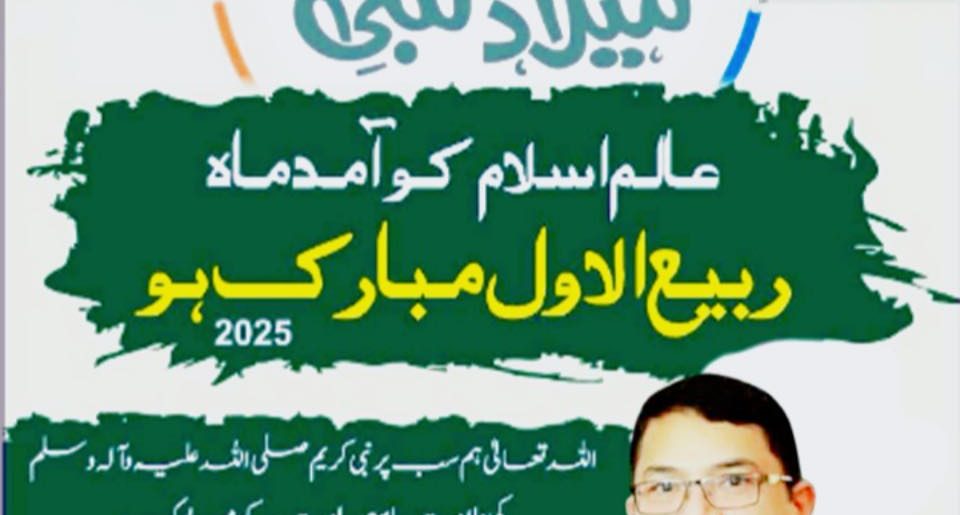
Prophet Muhammad (PBUH): Mercy to All Mankind | Seerah, Justice and Universal Compassion

A Month of Reflection and Renewal

In the blessed month of Rabi-ul-Awwal, hearts across the Muslim world turn toward the birth of the final Messenger, Prophet Muhammad (peace be upon him).

His life was not merely a historical chapter — it was a living embodiment of mercy, justice, patience, and moral courage.

For over fourteen centuries, his Seerah has illuminated civilizations and redefined ethical leadership.

Mercy Over Vengeance

Despite persecution, exile, and hardship, the Prophet (PBUH) consistently chose forgiveness over retaliation.

At the conquest of Makkah, when he stood in a position of absolute authority, he declared to former adversaries:

“Go, you are free.”

This was not political expediency.
It was principled mercy.

Compassion became the foundation of unity.

Knowledge as Liberation

The Prophet (PBUH) emphasized learning as a sacred obligation:

“Seeking knowledge is obligatory upon every Muslim man and woman.” (Ibn Majah)

He transformed the mosque into a center of scholarship, moral formation, and community cohesion.

Education, justice, and ethical conduct became pillars of Islamic civilization.

Women’s Rights — A Revolutionary Reform

In a 7th-century society marked by gender inequities, the Prophet (PBUH) introduced reforms that were unprecedented for their time.

The Qur’an affirmed:
• Women’s right to inheritance (Surah An-Nisa 4:7)
• Marriage by consent (Surah An-Nisa 4:19)
• Moral equality before God

He stated:

“The best among you are those who are best to their wives.” (Tirmidhi)

These were not symbolic statements.
They were structural reforms that reshaped social norms.

Universal Equality

In his Farewell Sermon, delivered during Hajj, the Prophet (PBUH) proclaimed:

“All mankind is from Adam and Eve. An Arab has no superiority over a non-Arab, nor a non-Arab over an Arab; a white over a black, nor a black over a white — except by piety.”

This declaration dismantled racial hierarchies centuries before modern human rights frameworks emerged.

More…
fb7

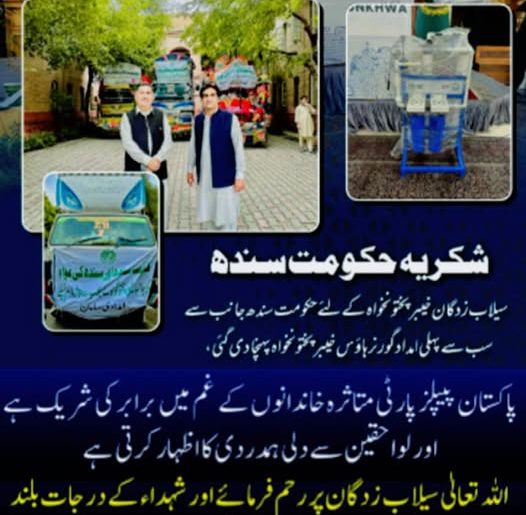
PPP Flood Relief in Khyber Pakhtunkhwa 2025 | Nationwide Aid & Free Healthcare for All

Pakistan Peoples Party mobilizes nationwide flood relief for Khyber Pakhtunkhwa while strengthening universal free healthcare through public-private partnerships and major public hospitals in Sindh serving the entire country.

High-Authority Keywords

PPP Flood Relief 2025, Khyber Pakhtunkhwa Floods, Bilawal Bhutto Zardari Relief Message, Pakistan Red Crescent Society, Universal Healthcare Pakistan, Indus Hospital Network, NICVD Karachi, SIUT Pakistan, JPMC Karachi, Public Health Equity Pakistan

United Against Disaster: A Test of National Solidarity

The 2025 floods in Khyber Pakhtunkhwa have once again reminded the nation of its climate vulnerability.
• Over 350 lives lost
• More than 150 individuals reported missing
• Thousands displaced
• Entire communities devastated

Homes collapsed. Families fractured. Livelihoods washed away.

Yet in moments of darkness, collective resolve often shines brightest.

More…
fb6

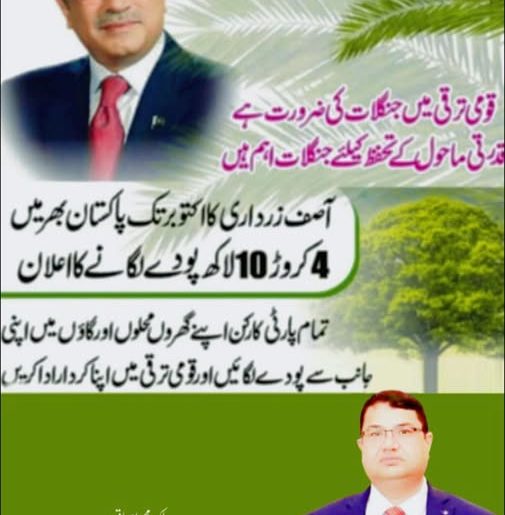
Asif Ali Zardari Announces 41 Million Tree Plantation Drive | Pakistan Climate Action Plan

A Nation at a Climate Crossroads

Pakistan has endured a series of catastrophic climate events between 2022 and 2025 — floods of historic magnitude, cloudbursts, extreme heatwaves, and infrastructure devastation. Thousands of lives were lost. Billions in economic damage followed. The country’s environmental vulnerability is no longer theoretical — it is measurable and urgent.

In this context, President Asif Ali Zardari’s announcement to plant 41 million trees nationwide represents more than symbolic environmentalism.

It is structural climate intervention.

This is not a ceremonial plantation drive.
It is strategic ecological stabilization.

Why Trees Matter: Scientific and Global Context

Forestation remains one of the most cost-effective climate mitigation tools available to developing economies.

Trees:
• Absorb carbon dioxide and reduce atmospheric warming
• Lower urban temperatures through natural cooling
• Improve rainfall patterns and microclimates
• Reduce soil erosion
• Act as natural flood buffers
• Strengthen biodiversity ecosystems

Countries such as China, Turkey, and United Arab Emirates have demonstrated that sustained afforestation programs significantly enhance environmental resilience.

For Pakistan — ranked among the most climate-vulnerable nations globally — this is not optional policy. It is survival architecture.

Deforestation: A Structural Threat

Illegal logging, land capture, and unchecked expansion have accelerated forest depletion. The consequences are visible:
• Increased flood intensity
• Soil degradation
• Disrupted rainfall cycles
• Agricultural instability

Deforestation is not merely environmental loss — it is intergenerational economic erosion.

The 41 million tree initiative must therefore be accompanied by:
• Strict anti-logging enforcement
• Severe penalties for illegal deforestation
• Protected forest zoning
• Community participation mechanisms
• Transparent monitoring systems

Plantation without protection is incomplete governance.

More…
fb5

Youth vs State Narrative in Pakistan | A Fact-Based Response to Disillusionment Claims

Introduction: The Power — and Risk — of Pessimistic Narratives

A recent opinion piece by Zureen Nizamani presents a familiar thesis: that Pakistan’s youth have turned away from the state, lost trust in institutions, and are quietly exiting a system deemed irreparable.

The argument is emotionally resonant and digitally consumable.
Yet it is analytically narrow, selectively evidenced, and strategically incomplete.

A serious national discussion requires more than sentiment — it requires proportion, context, and responsibility.

More…
fb4

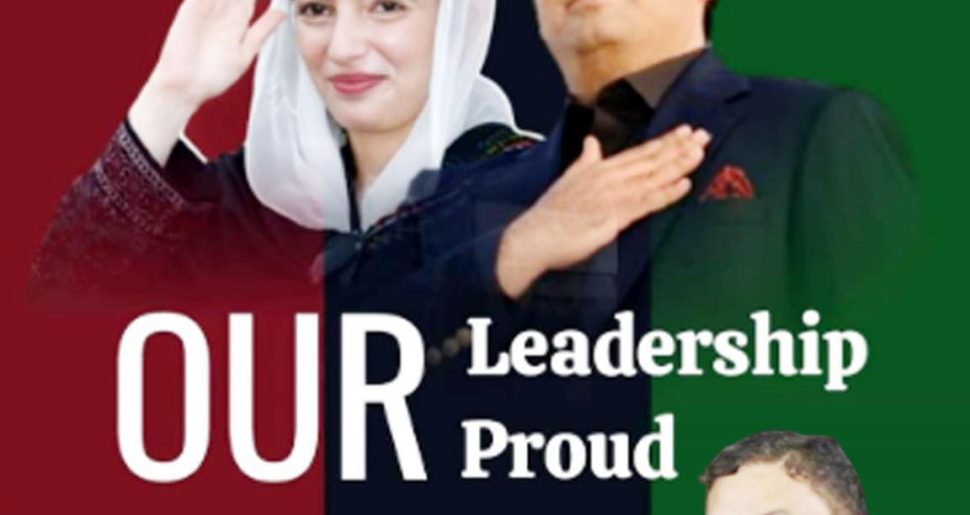
Renewal of Bhuttoism | Bilawal & Aseefa Bhutto Zardari and Pakistan’s Democratic Future

Bhuttoism Revisited — From Slogan to Governance

Bhuttoism has never been merely a political slogan.
It is a doctrine rooted in three enduring commitments:
• Economic dignity (“Roti, Kapra aur Makaan”)
• Federal balance
• Social justice with sovereign diplomacy

Today, its contemporary custodians are Bilawal Bhutto Zardari and Aseefa Bhutto Zardari — heirs not only to a name, but to an unfinished democratic project.

A Legacy Tempered by Sacrifice

Few political families in modern history have endured:
• The execution of Zulfikar Ali Bhutto in 1979
• The assassination of Benazir Bhutto in 2007

Sacrifice, in this narrative, is not rhetorical — it is historical.

The transition from grief to governance defines the Bhutto political inheritance.

Public Health and Humanitarian Diplomacy

Aseefa Bhutto Zardari has played a visible role in Pakistan’s public health campaigns, particularly in polio eradication advocacy, helping strengthen international cooperation frameworks that facilitated vaccine outreach to vulnerable populations.

Under Pakistan Peoples Party governance in Sindh:
• The expansion of the National Institute of Cardiovascular Diseases (NICVD) network increased free cardiac access across the province.
• JPMC’s CyberKnife facility enhanced cancer treatment accessibility.
• The Gambat Institute of Medical Sciences continued large-scale free liver transplant programs, exceeding 1,000 procedures.

Annual patient outreach across provincial public facilities has reached millions, reflecting a health-first policy orientation.

Housing, Ownership, and Women’s Empowerment

The Sindh People’s Housing initiatives, launched in response to catastrophic floods, aimed to provide climate-resilient housing to affected families.

A distinguishing feature of the program has been the issuance of ownership documentation in women’s names — transforming disaster recovery into structural empowerment.

Property rights, in this framework, are not symbolic — they are economic leverage.

Education and Institutional Continuity

Aseefa Bhutto Zardari has supported educational initiatives including the inauguration of the Shaheed Benazir Bhutto Block at Girls’ Cadet College Malir and engagement with development-focused schooling projects in rural regions.

Educational access, particularly for girls, remains central to the PPP’s federal and provincial philosophy of upward mobility.

Global Diplomacy and Pakistan’s Voice

As Foreign Minister, Bilawal Bhutto Zardari represented Pakistan at high-level international platforms including:
• The United Nations General Assembly (UNGA)
• The Shanghai Cooperation Organisation (SCO)
• Policy forums such as the Council on Foreign Relations (CFR)

His diplomatic positioning emphasized:
• Climate justice for vulnerable nations
• Multilateral cooperation
• Regional stability
• Sovereign equality

The conferral of Pakistan’s highest civilian decoration, the Nishan-e-Pakistan, further recognized his international diplomatic engagement and advocacy.

Political Consolidation and Youth Mobilization

In the 2024 general elections, the Pakistan Peoples Party secured 54 National Assembly seats, reflecting continued electoral viability in a competitive political environment.

Youth mobilization strategies, volunteer networks, and digital engagement were central to campaign expansion.

Bhuttoism’s renewal thus combines legacy with generational recalibration.

Social Inclusion Beyond Majoritarian Politics

Policy emphasis under PPP governance has included:
• Expansion of the Benazir Income Support Programme (BISP), reaching approximately nine million families
• Increased provincial health allocations
• Inclusion of marginalized communities within social welfare frameworks

These measures position Bhuttoism not as nostalgia — but as operational governance.

The Youth Framework and Democratic Strengthening

Bilawal and Aseefa articulate a political model centered on:
• Youth participation
• Women’s leadership
• Federal harmony
• Constitutional supremacy
• Pluralistic engagement

In polarized environments, inclusive vision becomes stabilizing capital.

Conclusion: Living Legacy, Not Archived History

Bilawal and Aseefa Bhutto Zardari represent more than continuity of lineage. They symbolize the evolution of Bhuttoism into a 21st-century framework — merging sacrifice with service, symbolism with systems.

Political legacies endure not because of memory alone — but because they adapt.

In that adaptation lies Pakistan’s democratic resilience.

Editorial Note to Readers

This article was originally published in Urdu in a Gulf/Middle East newspaper. For the convenience of international readers, a carefully translated English version is presented here while preserving the original meaning and context. The official source link is provided below.

https://www.facebook.com/100063646123366/posts/1350532563744935/?mibextid=wwXIfr&rdid=TaIArRp9edUvm6c9#

fb3

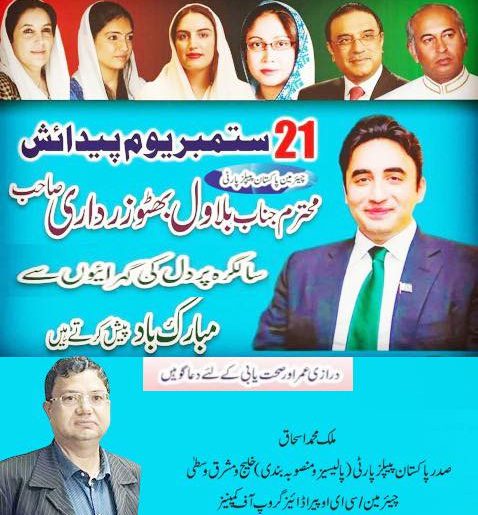
Bilawal Bhutto Zardari Turns 37 | Leadership, Legacy & Democratic Vision

A Birthday Beyond Celebration

A birthday can be personal.
Sometimes, it is historical.

As Bilawal Bhutto Zardari turns 37, the occasion represents more than a personal milestone. It symbolizes the continuity of a political legacy shaped not merely by inheritance — but by sacrifice.

His life intersects with defining chapters of Pakistan’s democratic evolution.

A Historic Beginning

Born on 21 September 1988, his arrival was global news: the son of Benazir Bhutto, the first woman Prime Minister of the Muslim world.

His birth was not simply a family event; it was perceived as a symbolic continuation of a political narrative already marked by upheaval, reform, and resistance.

Childhood Under Political Strain

Bilawal’s early years unfolded under circumstances unlike those of ordinary children.

His father, Asif Ali Zardari, faced prolonged imprisonment amid politically charged cases. His mother navigated governance, opposition pressures, and security threats simultaneously.

This was an upbringing shaped not by comfort alone — but by instability, scrutiny, and sacrifice.

Education and Formation

Educated in Dubai and later at the University of Oxford, Bilawal’s academic foundation combined international exposure with deep-rooted political inheritance.

Yet his most profound lessons were not confined to classrooms:
• The execution of his grandfather, Zulfikar Ali Bhutto
• His mother’s years of exile
• Her assassination in December 2007

These events were not distant history — they were personal realities.

Youth Interrupted

While peers experienced ordinary freedoms, Bilawal’s adolescence unfolded under the shadow of security threats and political responsibility.

Following his mother’s assassination, he assumed leadership responsibilities within the Pakistan Peoples Party at a remarkably young age. Grief did not silence him; it redefined his trajectory.

Pakistan’s Youngest Foreign Minister

In 2022, Bilawal Bhutto Zardari became Pakistan’s youngest Foreign Minister.

On international platforms — including the United Nations — he articulated Pakistan’s positions on:
• The Palestinian question
• The Kashmir dispute
• Climate vulnerability
• Regional stability

His diplomatic tone emphasized engagement over escalation, argument over hostility, and constitutional legitimacy over populist rhetoric.

A Public Stance Against Extremism

Bilawal has consistently framed Pakistan’s future around pluralism and democratic continuity.

His public statements often underscore that sustainable national progress rests upon:
• Tolerance
• Institutional supremacy
• Rule of law
• Peaceful coexistence

The phrase “Live and Let Live” reflects a broader ideological orientation: moderation as strength, not weakness.

Leadership Among the People

During the catastrophic floods of 2022, he visited affected regions and advocated internationally for climate justice and recovery support.

Reconstruction initiatives included commitments toward large-scale housing, with particular emphasis on empowering women through property ownership documentation.

Whether in flood zones or diplomatic halls, his political visibility has aimed to balance domestic engagement with global representation.

Women, Youth, and Institutional Development

His policy emphasis has included:
• Women’s economic empowerment
• Youth political participation
• Strengthening health infrastructure
• Upholding constitutional norms

Notably, he has refrained from endorsing personalized political hostility, even when responding to opposition actions — positioning his approach within institutional rather than individual frameworks.

A Different Political Tone

In a political environment often marked by polarization, Bilawal’s rhetoric has frequently leaned toward reconciliation and generational transition.

His public demeanor — accessible, composed, and empathetic — has shaped perceptions of him as a softer yet resolute face of Pakistani politics.

Strength, in this framing, emerges not from aggression but from continuity and composure.

Thirty-Seven Reflections

As he turns 37, supporters articulate aspirations for:
• Democratic stability
• Economic opportunity
• Climate resilience
• National unity
• Institutional strength
• International respect
• Peace over extremism
• Youth inclusion
• Women’s empowerment
• Justice without vengeance

These hopes extend beyond one individual — they reflect a generational expectation of progress grounded in constitutional democracy.

Conclusion

Bilawal Bhutto Zardari’s 37-year journey is intertwined with Pakistan’s democratic turbulence.

He embodies:
• A grandfather executed
• A mother assassinated
• A political tradition repeatedly tested

Whether history ultimately judges him as transformative will depend on policy outcomes and institutional endurance.

But at 37, he stands at the intersection of legacy and expectation — a figure shaped by loss, positioned for responsibility.

Editorial Note to Readers

This article was originally published in Urdu in a Gulf/Middle East newspaper. For the convenience of international readers, a carefully translated English version is presented here while preserving the original meaning and context. The official source link is provided below.

https://www.facebook.com/100063646123366/posts/1377833571014834/?mibextid=wwXIfr&rdid=taOJTneqWds4gWI7#

fb2

Why Youth Should Choose Pakistan Peoples Party | Bhutto Legacy, Democracy & Sacrifice

Leadership Is Not Inherited — It Is Forged in Trial

Some leaders are born into power.
Others are forged in adversity.

The Pakistan Peoples Party (PPP) does not demand blind loyalty from young citizens. It asks only this:
Study history honestly — and reflect with conscience.

The story of the PPP is not a narrative of privilege.
It is a chronicle of sacrifice — sustained across generations.

More…
fb1

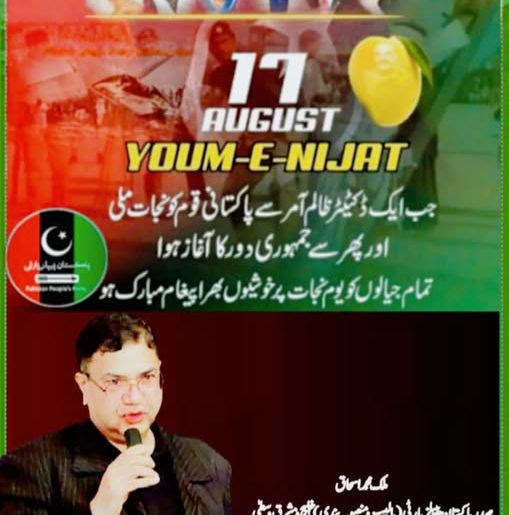
The day of the end of dictatorship, the new dawn of democracy

August 17, 1988 — The Day an Era of Martial Rule Ended and Pakistan Faced a Democratic Reckoning

By Malik Muhammad Ishaq
President, Pakistan Peoples Party (Policies & Planning – Gulf & Middle East)
Advocate for Justice and Human Rights

A Turning Point in Pakistan’s Political History

August 17, 1988 marks one of the most consequential days in Pakistan’s modern political trajectory. It was the day General Muhammad Zia-ul-Haq perished in a C-130 aircraft crash near Bahawalpur, abruptly ending an eleven-year period of military rule that began with the ousting of Prime Minister Zulfikar Ali Bhutto in July 1977.

Zia’s takeover dismantled an elected government and suspended constitutional governance. His regime reshaped Pakistan’s political, legal, and social architecture in ways whose consequences remain visible decades later.

The Overthrow of Democracy

In 1977, Pakistan’s fragile democratic order was interrupted when General Zia imposed martial law, citing political instability. What followed was not merely a change in leadership but a transformation in governance structure:
• Parliament was sidelined.
• Political parties were suppressed.
• Civil liberties were curtailed.
• The judiciary operated under sustained institutional pressure.

Most controversially, former Prime Minister Zulfikar Ali Bhutto was tried and executed in 1979 after a widely debated judicial process that international observers and historians continue to scrutinize.

Islamization and Institutional Restructuring

Zia’s regime introduced a series of Islamization policies, including the Hudood Ordinances and expanded Sharia-based legal provisions. While presented as moral reform, critics argue these measures:
• Politicized religion,
• Reshaped legal interpretation,
• Altered gender and civil rights discourse,
• Deepened sectarian fault lines.

The fusion of state power with religious rhetoric marked a defining feature of the era.

The Afghan War and Strategic Consequences

During the 1980s Soviet-Afghan War, Pakistan became a frontline state aligned with Western strategic objectives. Under Zia’s leadership, the country played a central role in supporting Afghan resistance groups.

The geopolitical alignment had long-term internal repercussions:
• Proliferation of small arms (the so-called “Kalashnikov culture”)
• Expansion of narcotics trafficking networks
• Rise of militant infrastructure
• Entrenchment of radicalized narratives

More…