

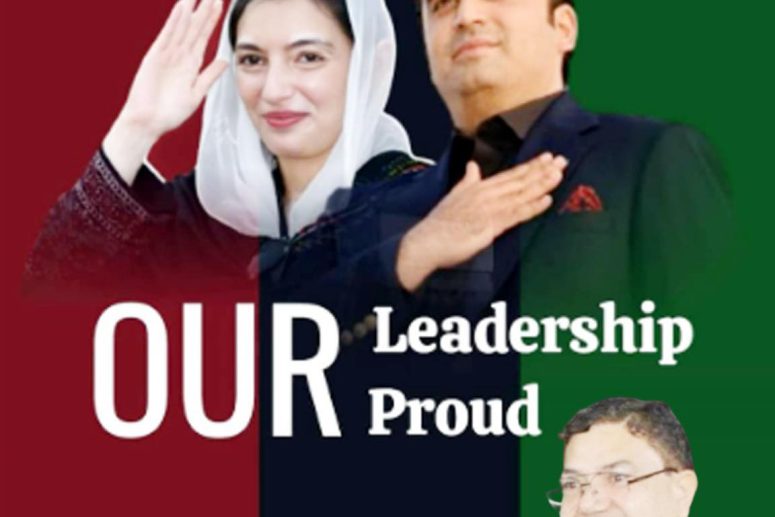
Bhuttoism Revisited — From Slogan to Governance
Bhuttoism has never been merely a political slogan.
It is a doctrine rooted in three enduring commitments:
• Economic dignity (“Roti, Kapra aur Makaan”)
• Federal balance
• Social justice with sovereign diplomacy
Today, its contemporary custodians are Bilawal Bhutto Zardari and Aseefa Bhutto Zardari — heirs not only to a name, but to an unfinished democratic project.
⸻
A Legacy Tempered by Sacrifice
Few political families in modern history have endured:
• The execution of Zulfikar Ali Bhutto in 1979
• The assassination of Benazir Bhutto in 2007
Sacrifice, in this narrative, is not rhetorical — it is historical.
The transition from grief to governance defines the Bhutto political inheritance.
⸻
Public Health and Humanitarian Diplomacy
Aseefa Bhutto Zardari has played a visible role in Pakistan’s public health campaigns, particularly in polio eradication advocacy, helping strengthen international cooperation frameworks that facilitated vaccine outreach to vulnerable populations.
Under Pakistan Peoples Party governance in Sindh:
• The expansion of the National Institute of Cardiovascular Diseases (NICVD) network increased free cardiac access across the province.
• JPMC’s CyberKnife facility enhanced cancer treatment accessibility.
• The Gambat Institute of Medical Sciences continued large-scale free liver transplant programs, exceeding 1,000 procedures.
Annual patient outreach across provincial public facilities has reached millions, reflecting a health-first policy orientation.
⸻
Housing, Ownership, and Women’s Empowerment
The Sindh People’s Housing initiatives, launched in response to catastrophic floods, aimed to provide climate-resilient housing to affected families.
A distinguishing feature of the program has been the issuance of ownership documentation in women’s names — transforming disaster recovery into structural empowerment.
Property rights, in this framework, are not symbolic — they are economic leverage.
⸻
Education and Institutional Continuity
Aseefa Bhutto Zardari has supported educational initiatives including the inauguration of the Shaheed Benazir Bhutto Block at Girls’ Cadet College Malir and engagement with development-focused schooling projects in rural regions.
Educational access, particularly for girls, remains central to the PPP’s federal and provincial philosophy of upward mobility.
⸻
Global Diplomacy and Pakistan’s Voice
As Foreign Minister, Bilawal Bhutto Zardari represented Pakistan at high-level international platforms including:
• The United Nations General Assembly (UNGA)
• The Shanghai Cooperation Organisation (SCO)
• Policy forums such as the Council on Foreign Relations (CFR)
His diplomatic positioning emphasized:
• Climate justice for vulnerable nations
• Multilateral cooperation
• Regional stability
• Sovereign equality
The conferral of Pakistan’s highest civilian decoration, the Nishan-e-Pakistan, further recognized his international diplomatic engagement and advocacy.
⸻
Political Consolidation and Youth Mobilization
In the 2024 general elections, the Pakistan Peoples Party secured 54 National Assembly seats, reflecting continued electoral viability in a competitive political environment.
Youth mobilization strategies, volunteer networks, and digital engagement were central to campaign expansion.
Bhuttoism’s renewal thus combines legacy with generational recalibration.
⸻
Social Inclusion Beyond Majoritarian Politics
Policy emphasis under PPP governance has included:
• Expansion of the Benazir Income Support Programme (BISP), reaching approximately nine million families
• Increased provincial health allocations
• Inclusion of marginalized communities within social welfare frameworks
These measures position Bhuttoism not as nostalgia — but as operational governance.
⸻
The Youth Framework and Democratic Strengthening
Bilawal and Aseefa articulate a political model centered on:
• Youth participation
• Women’s leadership
• Federal harmony
• Constitutional supremacy
• Pluralistic engagement
In polarized environments, inclusive vision becomes stabilizing capital.
⸻
Conclusion: Living Legacy, Not Archived History
Bilawal and Aseefa Bhutto Zardari represent more than continuity of lineage. They symbolize the evolution of Bhuttoism into a 21st-century framework — merging sacrifice with service, symbolism with systems.
Political legacies endure not because of memory alone — but because they adapt.
In that adaptation lies Pakistan’s democratic resilience.
⸻
Editorial Note to Readers
This article was originally published in Urdu in a Gulf/Middle East newspaper. For the convenience of international readers, a carefully translated English version is presented here while preserving the original meaning and context. The official source link is provided below.https://www.facebook.com/100063646123366/posts/1350532563744935/?mibextid=wwXIfr&rdid=TaIArRp9edUvm6c9#
⸻