

Pakistan Peoples Party mobilizes nationwide flood relief for Khyber Pakhtunkhwa while strengthening universal free healthcare through public-private partnerships and major public hospitals in Sindh serving the entire country.
High-Authority Keywords
PPP Flood Relief 2025, Khyber Pakhtunkhwa Floods, Bilawal Bhutto Zardari Relief Message, Pakistan Red Crescent Society, Universal Healthcare Pakistan, Indus Hospital Network, NICVD Karachi, SIUT Pakistan, JPMC Karachi, Public Health Equity Pakistan
⸻
United Against Disaster: A Test of National Solidarity
The 2025 floods in Khyber Pakhtunkhwa have once again reminded the nation of its climate vulnerability.
• Over 350 lives lost
• More than 150 individuals reported missing
• Thousands displaced
• Entire communities devastated
Homes collapsed. Families fractured. Livelihoods washed away.
Yet in moments of darkness, collective resolve often shines brightest.
⸻
Immediate Response: Provincial Solidarity Beyond Borders
The Pakistan Peoples Party (PPP) moved swiftly, demonstrating that provincial governance does not end at administrative boundaries.
From Sindh to Khyber Pakhtunkhwa:
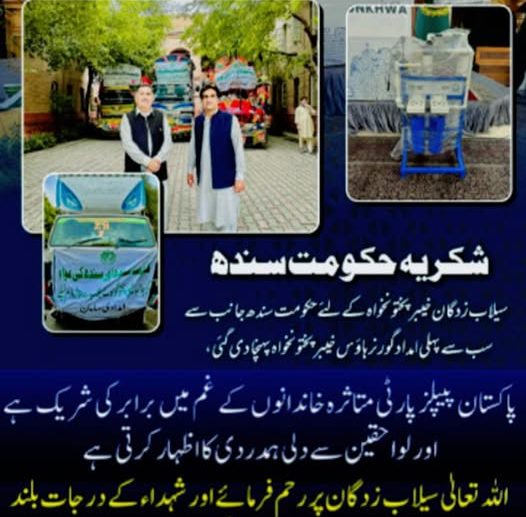
• 15 trucks of relief supplies dispatched
• 4,000 ration bags delivered
• 10 water filtration plants provided
The handover ceremony took place at Governor House Peshawar, with supplies formally transferred to the Pakistan Red Crescent Society (Khyber Pakhtunkhwa Chapter).
Officials present included provincial relief leadership and disaster management authorities, underscoring institutional coordination.
This was not symbolic politics — it was logistical execution.
⸻
Message from Bilawal Bhutto Zardari
Bilawal Bhutto Zardari called upon the federal government to accelerate aid distribution mechanisms and ensure rapid, transparent delivery to affected communities.
Disaster response, he emphasized, must transcend political divisions. Climate disasters do not recognize party lines.
National unity must be operational — not rhetorical.
⸻
Beyond Relief: Healthcare as a Constitutional Commitment
Emergency response is immediate. Public health is structural.
Sindh’s healthcare infrastructure, built under PPP governance, serves not only provincial residents but patients from across Pakistan.
⸻
Public–Private Partnership: Free, High-Quality Care
• Indus Hospital & Health Network
Free, modern healthcare services — from routine checkups to advanced treatment.
• Sindh Integrated Emergency and Health Services (SIEHS) – 1123 Ambulance Network
24/7 emergency response across Sindh.
• Tele-Tabeeb Telemedicine Services
Remote consultations extending medical advice nationwide.
⸻
Public Sector Institutions Serving the Entire Nation
• National Institute of Cardiovascular Diseases (NICVD) – Karachi
Free emergency cardiac care and life-saving surgeries.
• Sindh Institute of Urology and Transplantation (SIUT)
Free kidney care, dialysis, and transplant services.
• Jinnah Postgraduate Medical Centre (JPMC)
Trauma care, oncology, and complex treatments.
• Civil Hospital Karachi
Emergency services, surgeries, and specialized treatment.
These institutions operate on a principle rarely seen at scale in developing economies: treatment without discrimination and without cost.
Healthcare equity is not an abstract promise — it is an operational model.
⸻
The PPP Service Doctrine
The key pillars of the Pakistan Peoples Party’s governance philosophy remain:
• Rapid disaster response
• Cross-provincial solidarity
• Institutional strengthening
• Universal access to healthcare
• Service without discrimination
Flood relief demonstrates immediate compassion.
Healthcare infrastructure demonstrates long-term commitment.
Together, they form a governance continuum.
⸻
Conclusion: Hope Through Action
When floods destroy homes, relief trucks carry more than supplies — they carry reassurance.
When hospitals treat patients free of charge, they deliver more than medicine — they deliver dignity.
The Pakistan Peoples Party’s model reflects a broader proposition:
National strength is measured not only in economic metrics, but in how it protects its most vulnerable.
Share awareness. Spread informed dialogue. Strengthen unity.
⸻
Editorial Note to Readers
This article was originally published in Urdu in a Gulf/Middle East newspaper. For the convenience of international readers, a carefully translated English version is presented here while preserving the original meaning and context. The official source link is provided below.https://www.facebook.com/100063646123366/posts/1348005123997679/?mibextid=wwXIfr&rdid=w20kucY7Ucu9dq6I#
⸻