

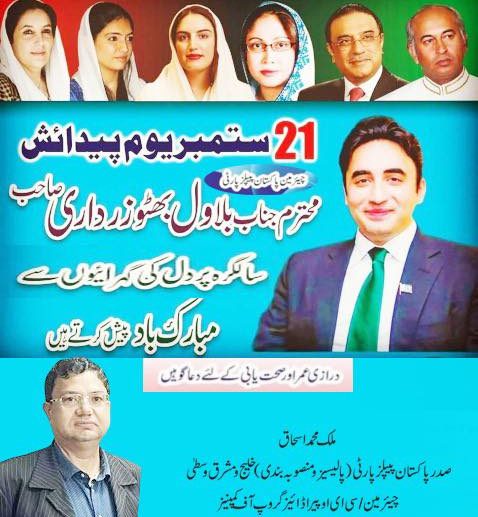
A Birthday Beyond Celebration
A birthday can be personal.
Sometimes, it is historical.
As Bilawal Bhutto Zardari turns 37, the occasion represents more than a personal milestone. It symbolizes the continuity of a political legacy shaped not merely by inheritance — but by sacrifice.
His life intersects with defining chapters of Pakistan’s democratic evolution.
⸻
A Historic Beginning
Born on 21 September 1988, his arrival was global news: the son of Benazir Bhutto, the first woman Prime Minister of the Muslim world.
His birth was not simply a family event; it was perceived as a symbolic continuation of a political narrative already marked by upheaval, reform, and resistance.
⸻
Childhood Under Political Strain
Bilawal’s early years unfolded under circumstances unlike those of ordinary children.
His father, Asif Ali Zardari, faced prolonged imprisonment amid politically charged cases. His mother navigated governance, opposition pressures, and security threats simultaneously.
This was an upbringing shaped not by comfort alone — but by instability, scrutiny, and sacrifice.
⸻
Education and Formation
Educated in Dubai and later at the University of Oxford, Bilawal’s academic foundation combined international exposure with deep-rooted political inheritance.
Yet his most profound lessons were not confined to classrooms:
• The execution of his grandfather, Zulfikar Ali Bhutto
• His mother’s years of exile
• Her assassination in December 2007
These events were not distant history — they were personal realities.
⸻
Youth Interrupted
While peers experienced ordinary freedoms, Bilawal’s adolescence unfolded under the shadow of security threats and political responsibility.
Following his mother’s assassination, he assumed leadership responsibilities within the Pakistan Peoples Party at a remarkably young age. Grief did not silence him; it redefined his trajectory.
⸻
Pakistan’s Youngest Foreign Minister
In 2022, Bilawal Bhutto Zardari became Pakistan’s youngest Foreign Minister.
On international platforms — including the United Nations — he articulated Pakistan’s positions on:
• The Palestinian question
• The Kashmir dispute
• Climate vulnerability
• Regional stability
His diplomatic tone emphasized engagement over escalation, argument over hostility, and constitutional legitimacy over populist rhetoric.
⸻
A Public Stance Against Extremism
Bilawal has consistently framed Pakistan’s future around pluralism and democratic continuity.
His public statements often underscore that sustainable national progress rests upon:
• Tolerance
• Institutional supremacy
• Rule of law
• Peaceful coexistence
The phrase “Live and Let Live” reflects a broader ideological orientation: moderation as strength, not weakness.
⸻
Leadership Among the People
During the catastrophic floods of 2022, he visited affected regions and advocated internationally for climate justice and recovery support.
Reconstruction initiatives included commitments toward large-scale housing, with particular emphasis on empowering women through property ownership documentation.
Whether in flood zones or diplomatic halls, his political visibility has aimed to balance domestic engagement with global representation.
⸻
Women, Youth, and Institutional Development
His policy emphasis has included:
• Women’s economic empowerment
• Youth political participation
• Strengthening health infrastructure
• Upholding constitutional norms
Notably, he has refrained from endorsing personalized political hostility, even when responding to opposition actions — positioning his approach within institutional rather than individual frameworks.
⸻
A Different Political Tone
In a political environment often marked by polarization, Bilawal’s rhetoric has frequently leaned toward reconciliation and generational transition.
His public demeanor — accessible, composed, and empathetic — has shaped perceptions of him as a softer yet resolute face of Pakistani politics.
Strength, in this framing, emerges not from aggression but from continuity and composure.
⸻
Thirty-Seven Reflections
As he turns 37, supporters articulate aspirations for:
• Democratic stability
• Economic opportunity
• Climate resilience
• National unity
• Institutional strength
• International respect
• Peace over extremism
• Youth inclusion
• Women’s empowerment
• Justice without vengeance
These hopes extend beyond one individual — they reflect a generational expectation of progress grounded in constitutional democracy.
⸻
Conclusion
Bilawal Bhutto Zardari’s 37-year journey is intertwined with Pakistan’s democratic turbulence.
He embodies:
• A grandfather executed
• A mother assassinated
• A political tradition repeatedly tested
Whether history ultimately judges him as transformative will depend on policy outcomes and institutional endurance.
But at 37, he stands at the intersection of legacy and expectation — a figure shaped by loss, positioned for responsibility.
⸻
Editorial Note to Readers
This article was originally published in Urdu in a Gulf/Middle East newspaper. For the convenience of international readers, a carefully translated English version is presented here while preserving the original meaning and context. The official source link is provided below.https://www.facebook.com/100063646123366/posts/1377833571014834/?mibextid=wwXIfr&rdid=taOJTneqWds4gWI7#
⸻