

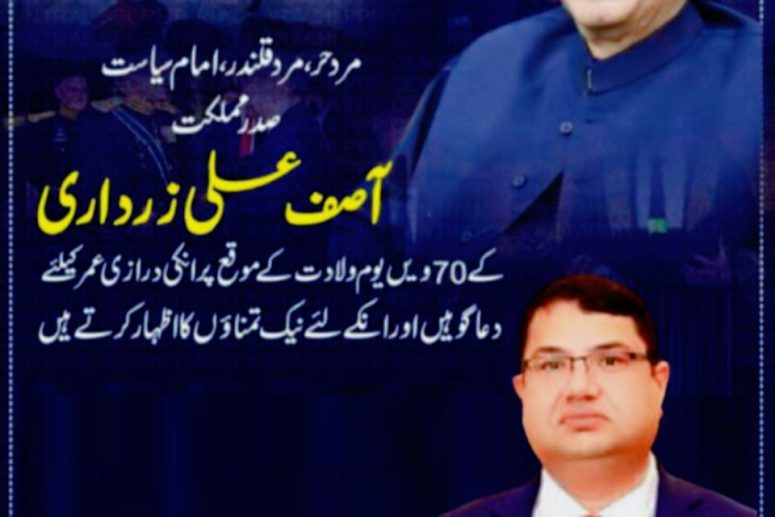
A Life Defined by Endurance
Today, we extend heartfelt birthday wishes to Asif Ali Zardari — the 11th President of Pakistan — whose political journey reflects resilience, constitutional fidelity, and democratic continuity.
This is not merely a celebration of age.
It is recognition of endurance.
From standing beside the martyred Benazir Bhutto during the most turbulent chapters of Pakistan’s political history, to assuming leadership responsibilities under national trauma, his trajectory has been marked by composure under pressure.
⸻
Trials, Allegations, and Due Process
Over decades, Asif Ali Zardari faced multiple legal cases, investigations, political accusations, and imprisonment.
These included:
• Accountability proceedings
• Financial misconduct allegations
• High-profile political controversies
He consistently appeared before courts and navigated legal processes within institutional frameworks. Supporters argue that many cases were politically motivated; critics maintain scrutiny was necessary.
What remains uncontested is that he endured prolonged incarceration without political exile and remained within the constitutional arena.
In democratic systems, history ultimately evaluates leaders by institutional outcomes — not only accusations.
⸻
Constitutional and Democratic Milestones
During his presidency (2008–2013), Pakistan witnessed several landmark developments:
📜 Restoration of the 1973 Constitution
Reinforcing parliamentary sovereignty and civilian governance.
🏛 18th Constitutional Amendment
A historic transfer of powers from the presidency to Parliament and the provinces — strengthening federalism.
💰 NFC Award Reform
Enhanced provincial fiscal autonomy and resource distribution.
🕊 Completion of a Full Democratic Term
The first elected civilian government in Pakistan’s history to complete a five-year term and transfer power constitutionally.
🔄 Voluntary Reduction of Presidential Powers
Returning executive authorities to Parliament — a rare act in political history.
These measures strengthened institutional democracy beyond individual tenure.
⸻
Federal Harmony and National Integration
Under his leadership:
• The North-West Frontier Province was constitutionally renamed Khyber Pakhtunkhwa, acknowledging regional identity.
• The Aghaz-e-Huqooq-e-Balochistan package initiated reconciliation efforts in Balochistan.
• Worker wage increases and social safety programs were expanded.
Reconciliation — not confrontation — defined his political vocabulary.
⸻
Diplomatic Engagement and Strategic Balancing
As President, Asif Ali Zardari maintained engagement across multiple global axes:
• Strengthened relations with China, laying early groundwork for long-term infrastructure cooperation later associated with CPEC.
• Advanced dialogue with Iran on energy connectivity.
• Reinforced economic engagement with Turkey.
• Sustained working relations with United States and the European Union.
His approach emphasized strategic balance rather than polarization.
⸻
Politics of Reconciliation
Unlike adversarial traditions that thrive on perpetual conflict, his leadership model was often described as one of “mufahamat” — reconciliation.
He engaged opponents.
He absorbed criticism.
He prioritized systemic continuity over personal confrontation.
In polarized democracies, stability itself becomes achievement.
⸻
A Message to the Younger Generation
Political awareness is not merely sloganism.
It is the discipline of sustaining institutions even under provocation.
Asif Ali Zardari’s career offers lessons in:
• Patience under political hostility
• Respect for constitutional procedure
• Long-term institutional thinking
• Federal balance
Leadership is not defined only by applause — but by persistence.
⸻
A National Greeting
On this occasion, we extend respectful birthday wishes to President Asif Ali Zardari.
His life remains intertwined with Pakistan’s democratic evolution — marked by sacrifice, controversy, negotiation, and institutional reform.
History ultimately measures leaders not by noise — but by the systems they leave behind.
⸻
Editorial Note
This article was originally written in Urdu for publication in a Gulf/Middle East newspaper. For international readers, a carefully translated and contextually structured English version is presented here while preserving the political and historical nuance of the original text.https://www.facebook.com/100063646123366/posts/1326295616168630/?mibextid=wwXIfr&rdid=RQP5RrWQ6Z7r3wpE#
⸻