

Recognition and the Culture of Merit
Every nation honors individuals who demonstrate excellence in service, diplomacy, science, arts, or governance. Recognition is not merely ceremonial — it shapes national identity and inspires future generations.
When a public figure receives a civilian award, the question is not partisan preference. The question is merit, measurable contribution, and national representation.
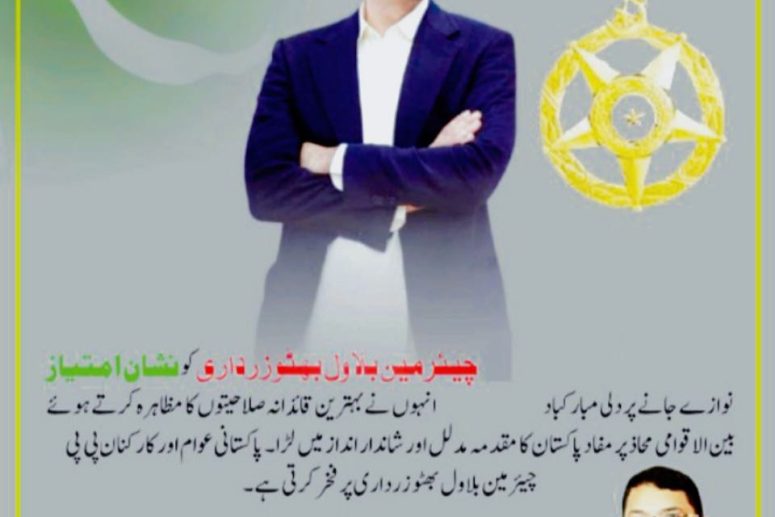
Recent recognition of Bilawal Bhutto Zardari has sparked debate — as is natural in a vibrant democracy. Yet evaluation must be grounded in performance, not political sentiment.
⸻
Why Civilian Awards Exist
Globally respected honors — from the Nobel Prize to the Oscar and the Pulitzer — are designed to:
• Recognize exceptional contribution
• Encourage excellence
• Institutionalize appreciation for service
• Create role models for future generations
Similarly, Pakistan’s civil awards system — including the Nishan-e-Pakistan, Nishan-e-Imtiaz, Hilal-e-Pakistan, Sitara-e-Pakistan, and Tamgha-e-Pakistan — exists to formally acknowledge extraordinary service to the state.
Recognition is not privilege.
It is institutional affirmation.
⸻
Historical Continuity of Recognition in Pakistan
Pakistan has historically honored leaders across political spectrums for diplomatic, constitutional, and governance contributions.
For example:
• Zulfikar Ali Bhutto was recognized for diplomatic leadership and constitutional architecture.
• Benazir Bhutto received acknowledgment for democratic restoration and international engagement.
Civilian awards are not ideological endorsements; they are acknowledgments of service rendered.
⸻
Political Difficulty in Pakistan
Pakistan’s political history is marked by turbulence:
• Execution of an elected Prime Minister in 1979
• Exile and imprisonment of civilian leaders
• Removal of governments through constitutional and extra-constitutional means
• Persistent media trials and reputational campaigns
Political service in Pakistan has rarely been linear or insulated from controversy.
Recognition, therefore, must be evaluated in the context of contribution — not narrative warfare.
⸻
War and Diplomacy: Dual Pillars of National Strength
History repeatedly demonstrates that military developments alone do not secure long-term national outcomes.
Following the 1971 war, nearly 93,000 Pakistani prisoners of war were held by India. Diplomatic engagement ultimately shaped repatriation and strategic recalibration.
Similarly, in the 1973 Arab–Israeli War, battlefield developments were followed by intense diplomatic maneuvering that shaped long-term outcomes.
The lesson is clear:
Military posture and diplomatic engagement are complementary — not competing — instruments of statecraft.
⸻
Diplomatic Record (2022–2023 and Beyond)
During his tenure as Foreign Minister (2022–2023), Bilawal Bhutto Zardari:
• Participated in over 30 high-level international engagements
• Advocated for climate justice following Pakistan’s catastrophic floods
• Represented Pakistan at the United Nations General Assembly
• Engaged regional platforms including the Shanghai Cooperation Organisation (SCO)
• Conducted bilateral diplomacy with Western and regional stakeholders
Following periods of regional tension often described domestically as “Marka-e-Haq,” diplomatic outreach in the United States and Europe aimed to articulate Pakistan’s position within international forums.
Diplomacy is rarely dramatic.
Its impact is often measured in stabilization rather than spectacle.
⸻
The Question of Merit
Debate surrounding civilian awards often reflects broader political polarization.
The essential question remains:
Was recognition based on demonstrable diplomatic activity, global representation, and state advocacy?
If the answer is grounded in performance metrics and official record, then the award reflects institutional procedure — not favoritism.
⸻
Political Discourse and Personal Attacks
Pakistan’s political culture has frequently drifted toward personal labeling, rhetorical hostility, and digital misinformation campaigns.
Healthy democratic competition requires:
• Policy critique
• Institutional accountability
• Evidence-based argument
It does not require personal degradation.
Merit must be contested through facts — not insults.
⸻
Youth Leadership and National Image
Bilawal Bhutto Zardari represents a generational shift within Pakistani politics — one shaped by:
• Multilateral diplomacy
• Climate advocacy
• Institutional engagement
• Youth-oriented political messaging
Whether one supports or opposes his political ideology, assessment of service must remain analytical rather than emotional.
Recognition of merit does not negate democratic debate.
It affirms measurable contribution.
⸻
Conclusion: A Mature Political Culture Requires Balance
Pakistan’s democratic maturity depends on three principles:
1. Merit-based recognition
2. Constructive criticism
3. Institutional respect
Civilian honors acknowledge service.
Debate refines democracy.
Balance strengthens nations.
The broader national interest lies not in dismissing achievement reflexively, nor in romanticizing it uncritically — but in evaluating it soberly.
A confident nation honors service where due — and debates policy without diminishing institutional dignity.
⸻
Editorial Note
This article was originally published in Urdu in a Gulf/Middle East newspaper. For the convenience of international readers, a carefully translated English version is presented here while preserving the original meaning and context. The official source link is provided below.https://www.facebook.com/100063646123366/posts/1345015544296637/?mibextid=wwXIfr&rdid=kIO4CA6JBrJmCRAN#
⸻