

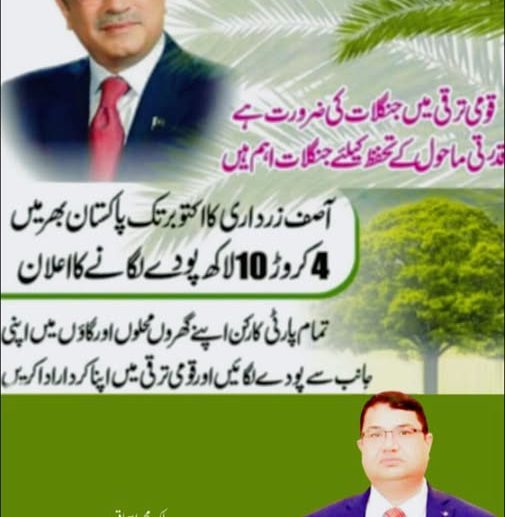
A Nation at a Climate Crossroads
Pakistan has endured a series of catastrophic climate events between 2022 and 2025 — floods of historic magnitude, cloudbursts, extreme heatwaves, and infrastructure devastation. Thousands of lives were lost. Billions in economic damage followed. The country’s environmental vulnerability is no longer theoretical — it is measurable and urgent.
In this context, President Asif Ali Zardari’s announcement to plant 41 million trees nationwide represents more than symbolic environmentalism.
It is structural climate intervention.
This is not a ceremonial plantation drive.
It is strategic ecological stabilization.
⸻
Why Trees Matter: Scientific and Global Context
Forestation remains one of the most cost-effective climate mitigation tools available to developing economies.
Trees:
• Absorb carbon dioxide and reduce atmospheric warming
• Lower urban temperatures through natural cooling
• Improve rainfall patterns and microclimates
• Reduce soil erosion
• Act as natural flood buffers
• Strengthen biodiversity ecosystems
Countries such as China, Turkey, and United Arab Emirates have demonstrated that sustained afforestation programs significantly enhance environmental resilience.
For Pakistan — ranked among the most climate-vulnerable nations globally — this is not optional policy. It is survival architecture.
⸻
Deforestation: A Structural Threat
Illegal logging, land capture, and unchecked expansion have accelerated forest depletion. The consequences are visible:
• Increased flood intensity
• Soil degradation
• Disrupted rainfall cycles
• Agricultural instability
Deforestation is not merely environmental loss — it is intergenerational economic erosion.
The 41 million tree initiative must therefore be accompanied by:
• Strict anti-logging enforcement
• Severe penalties for illegal deforestation
• Protected forest zoning
• Community participation mechanisms
• Transparent monitoring systems
Plantation without protection is incomplete governance.
⸻
Climate Events and Systemic Imbalance
Floods, droughts, and cloudbursts are not isolated anomalies — they are symptoms of ecological imbalance.
Nature operates as an integrated system. When forests disappear, water flows intensify, soil weakens, and temperature rises. The climate crisis is therefore not a distant forecast — it is a governance imperative of the present.
Reforestation is the first and most scalable corrective intervention available.
⸻
From Environmentalism to Economic Policy
A 41 million tree campaign can generate:
• Rural employment
• Community-based green enterprises
• Carbon credit potential
• Public–private sustainability partnerships
Climate policy is increasingly economic policy.
Investing in forests today reduces disaster recovery expenditure tomorrow.
⸻
A Generational Responsibility
This initiative signals a transition from reactive disaster response to proactive environmental architecture.
It aligns with:
• Flood reconstruction frameworks
• Climate adaptation planning
• Long-term sustainability commitments
• International environmental obligations
Planting trees is not sentiment.
It is infrastructure for national survival.
⸻
Conclusion: One Tree, One Future, One Nation
President Asif Ali Zardari’s announcement is generational in scope.
If implemented with transparency, enforcement, and public ownership, the 41 million tree initiative can:
• Strengthen disaster resilience
• Restore ecological balance
• Enhance agricultural sustainability
• Improve public health outcomes
• Protect future generations
Climate resilience begins at the root.
One tree is not merely a plant.
It is policy.
It is protection.
It is investment in Pakistan’s tomorrow.
⸻
Editorial Note to Readers
This article was originally published in Urdu in a Gulf/Middle East newspaper. For the convenience of international readers, a carefully translated English version is presented here while preserving the original meaning and context. The official source link is provided below.https://www.facebook.com/100063646123366/posts/1348670590597799/?mibextid=wwXIfr&rdid=AYtJ4hiuIpXJKOy1#
⸻