

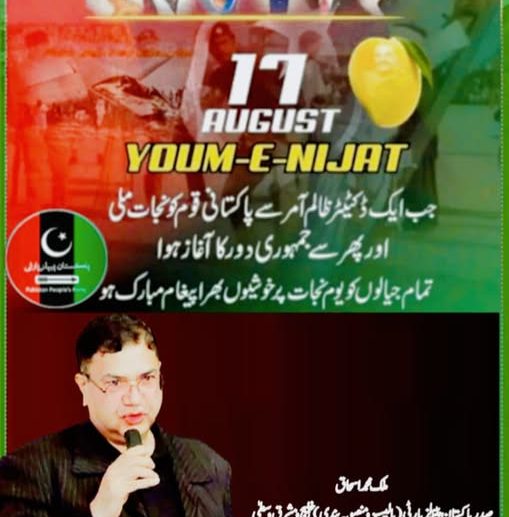
August 17, 1988 — The Day an Era of Martial Rule Ended and Pakistan Faced a Democratic Reckoning
By Malik Muhammad Ishaq
President, Pakistan Peoples Party (Policies & Planning – Gulf & Middle East)
Advocate for Justice and Human Rights
⸻
A Turning Point in Pakistan’s Political History
August 17, 1988 marks one of the most consequential days in Pakistan’s modern political trajectory. It was the day General Muhammad Zia-ul-Haq perished in a C-130 aircraft crash near Bahawalpur, abruptly ending an eleven-year period of military rule that began with the ousting of Prime Minister Zulfikar Ali Bhutto in July 1977.
Zia’s takeover dismantled an elected government and suspended constitutional governance. His regime reshaped Pakistan’s political, legal, and social architecture in ways whose consequences remain visible decades later.
⸻
The Overthrow of Democracy
In 1977, Pakistan’s fragile democratic order was interrupted when General Zia imposed martial law, citing political instability. What followed was not merely a change in leadership but a transformation in governance structure:
• Parliament was sidelined.
• Political parties were suppressed.
• Civil liberties were curtailed.
• The judiciary operated under sustained institutional pressure.
Most controversially, former Prime Minister Zulfikar Ali Bhutto was tried and executed in 1979 after a widely debated judicial process that international observers and historians continue to scrutinize.
⸻
Islamization and Institutional Restructuring
Zia’s regime introduced a series of Islamization policies, including the Hudood Ordinances and expanded Sharia-based legal provisions. While presented as moral reform, critics argue these measures:
• Politicized religion,
• Reshaped legal interpretation,
• Altered gender and civil rights discourse,
• Deepened sectarian fault lines.
The fusion of state power with religious rhetoric marked a defining feature of the era.
⸻
The Afghan War and Strategic Consequences
During the 1980s Soviet-Afghan War, Pakistan became a frontline state aligned with Western strategic objectives. Under Zia’s leadership, the country played a central role in supporting Afghan resistance groups.
The geopolitical alignment had long-term internal repercussions:
• Proliferation of small arms (the so-called “Kalashnikov culture”)
• Expansion of narcotics trafficking networks
• Rise of militant infrastructure
• Entrenchment of radicalized narratives
What began as Cold War strategy evolved into a domestic security challenge that Pakistan continues to confront.
⸻
Economic and Social Impact (1977–1988)
The period saw selective economic growth supported by foreign aid inflows; however:
• Institutional development lagged behind.
• Democratic continuity was interrupted.
• Education and social services did not receive structural transformation.
• Political polarization deepened.
The absence of representative accountability left long-term governance gaps.
⸻
A Historical Pattern: Power and Consequence
History repeatedly demonstrates that unchecked authority, whether ancient or modern, eventually confronts accountability.
From authoritarian rulers in ancient civilizations to 20th-century military regimes, concentration of power without public mandate has rarely endured indefinitely. Pakistan’s own experience — from Ayub Khan to Yahya Khan, and later Pervez Musharraf — reflects the recurring tension between military authority and civilian sovereignty.
⸻
The Democratic Lesson
The end of Zia’s rule did not instantly restore democratic stability, but it reopened political space. Elections followed. Civilian leadership returned. Political discourse revived.
The deeper lesson of August 17 is not about an individual — it is about institutional balance.
Sustainable nations are built upon:
• Constitutional supremacy
• Independent judiciary
• Parliamentary authority
• Civilian oversight
• Political pluralism
Military intervention may promise order, but history suggests that durable stability emerges only through democratic legitimacy.
⸻
Message for the Present
Pakistan’s democratic journey has been uneven, yet the aspiration for representative governance remains deeply embedded in public consciousness.
Authoritarian rule may appear decisive in moments of crisis, but enduring progress requires institutions stronger than individuals.
The lesson of 17 August 1988 is clear:
Power imposed may command fear.
Power earned through public mandate commands respect.
⸻
Editorial Note to Readers
This article was originally published in Urdu in a Gulf/Middle East newspaper. For the convenience of international readers, a carefully translated and contextually aligned English version is presented here. The original publication link is provided below for reference.https://www.facebook.com/100063646123366/posts/pfbid02JBhkgA1gX9S7so6GjarwL8ZZq4gLbN957BPcmcznFirbdMNQDjiR4Fstg31pK5PDl/?mibextid=wwXIfr